This is default featured slide 1 title

Go to Blogger edit html and find these sentences.Now replace these sentences with your own descriptions.This theme is Bloggerized by Lasantha Bandara - Premiumbloggertemplates.com.

This is default featured slide 2 title

Go to Blogger edit html and find these sentences.Now replace these sentences with your own descriptions.This theme is Bloggerized by Lasantha Bandara - Premiumbloggertemplates.com.

This is default featured slide 3 title

Go to Blogger edit html and find these sentences.Now replace these sentences with your own descriptions.This theme is Bloggerized by Lasantha Bandara - Premiumbloggertemplates.com.

This is default featured slide 4 title

Go to Blogger edit html and find these sentences.Now replace these sentences with your own descriptions.This theme is Bloggerized by Lasantha Bandara - Premiumbloggertemplates.com.

This is default featured slide 5 title

Go to Blogger edit html and find these sentences.Now replace these sentences with your own descriptions.This theme is Bloggerized by Lasantha Bandara - Premiumbloggertemplates.com.

Tuesday, April 4, 2023

Digital health funding in Q1 buoyed by 6 deals

https://ift.tt/iL2vjaQ

The new reality for digital health funding was present in the first quarter of 2023 despite a slight uptick in mega deals.

A report from Rock Health, a research and digital health venture firm, showed funding for the first three months of 2023 totaled $3.4 billion across 132 total deals. Six mega deals with more than $100 million in funding accounted for 40% of this total. The six deals were from Monogram Health ($375M), ShiftKey ($300M), Paradigm ($203M), ShiftMed ($200M), Gravie ($179M) and Vytalize Health ($100M).

Related: Digital health funding takes a dive in 2022

There were the same number of mega deals from the past three months as there were the entire second half of 2022. But even with this early momentum for large deals, funding throughout the sector has slowed. Throughout the first three months of 2023, digital health companies received $3.4 billion in funding. In each of the past two years, those first-quarter totals topped $6 billion.

Experts say founders seeking venture capital backing just don’t have as much leverage as in previous years.

“Investors are pickier in terms of the solutions they see in the market,” said Peter Micca, national health tech leader in Deloitte’s audit practice. “They want to see a track record. They want to see the size of the [total market demand].”

Investors echoed similar sentiments. Their expectations for digital health companies have fundamentally changed in the past 18 months.

“If anyone didn’t believe we were in a different market condition, [Silicon Valley Bank’s failure] put a stamp on it,” said Dr. Justin Norden, a partner at venture capital firm GSR Ventures. “The world is different.”

The Rock Health report shows that those six larger deals lifted the entire sector. Adriana Krasniansky, research manager at Rock Health, said these deals came from venture firms that had leftover financial reserves and that are selectively choosing which companies to fund.

Not a Modern Healthcare subscriber? Sign up today.

Other venture firms without these reserves are holding off. Even with six deals greater than $100 million, the number of later-stage deals dropped precipitously. In 2021, there were 149 Series C and later deals. In 2022, there were a total of 70. Through the first quarter in 2023, there were only 10 later-stage deals. There were 183 deals in the first quarter of 2022 compared to 132 in 2023.

“There used to be a discount for health tech versus other parts of tech because people knew healthcare was harder,” Norden said. “Those models have all soured somewhat from an investor standpoint when capital is more expensive.”

Uncertainty at root of shifting expectations

While investors and experts are still encouraged by healthcare’s need for new digital solutions, they say the overall environment won’t be as friendly for founders.

“I think it’s going to be a tough year for founders,” Krasniansky said. “The funding approach right now is really difficult.”

The shift is leading some founders to consider exit opportunities. Pear Therapeutics, a digital therapeutics company, said last month without financial help it may need to liquidate or restructure.  Mindstrong, a digital mental health company, sold its technology assets to a former competitor last month after shuttering its patient service offerings.

While macroeconomic factors are at play, the nascent nature of digital health and uncertainty over of how companies will be valued long term could be partially to blame, experts say.

“What kind of multiples do you assign on early growth stories that have yet to achieve profitability?” asked Scott Schoenhaus, managing director of healthcare IT equity research at KeyBanc Capital Markets. “I think that’s probably part of the reason you’ve seen pullback from venture capitalists and private equity funding.”

This story first appeared in Digital Health Business & Technology.


Source link

source https://financetin.com/digital-health-funding-in-q1-buoyed-by-6-deals/financetin.com

Monday, April 3, 2023

Infinigate Group Appoints Kristiina Leppänen as new Chief Financial Officer

https://ift.tt/SJpFXIQ

Rotkreuz, Switzerland: 03/04/23: The Infinigate Group, the value-add distributor of cybersecurity, secure network and secure cloud, is appointing Kristiina Leppänen as the new Chief Financial Officer.

Kristiina brings over 25 years’ experience in international finance and leadership, with deep expertise in M&A, change management and a strong track record of value creation. This is demonstrated by the key role she played in the creation of Europe’s second largest Electronics Manufacturing Services, having been instrumental to the successful merger of two companies, the Enics Group and GPV International, and having driven profitable growth globally.

Kristiina Leppänen

Kristiina Leppänen

Kristiina helps to steer the next phase of the Infinigate Group’s evolution, following its considerable expansion through both organic and acquisitive growth, to achieve the potential inherent in the combined assets of the Infinigate Group and the buoyant cybersecurity market.

“I am excited to join the Infinigate Group at this important juncture, with a world of opportunity ahead. I look forward to applying my knowledge and experience, adding structure and realising our considerable potential by working in close alignment with the teams, in what is clearly a high-energy environment.”

In addition to her financial expertise, Kristiina is a skilled people leader and places particular focus on fostering group spirit and promoting fruitful collaboration.

Klaus Schlichtherle, Chief Executive Officer of the Infinigate Group, says: “I am delighted to welcome Kristiina to the Infinigate Group family. Her talent and experience provides us with the financial steering needed for our next phase of growth – to our €5B revenue target by 2027.”

About the Infinigate Group
The Infinigate Group is a value-add distributor, fully committed to sustainable, leading-edge cybersecurity solutions. Founded in 1996 in Switzerland, it has grown to incorporate the entire EMEA region, with offices in 30 countries and partners in more than 50. Our more than 1,200 dedicated employees, half of them with in-depth technical knowledge, are passionate about best-of-breed cybersecurity, secure networks and secure cloud for SMB and enterprise market segments, for on-premise and cloud-based IT infrastructure. The Infinigate Group relies on strong country organisations, which can adapt to the needs of their respective partners, MSSPs and vendors, by providing technical, marketing, sales and professional services. For additional information visit: http://www.infinigate.com/

Since 2022 Nuvias, Vuzion and Starlink are part of the Infinigate Group. Find out more about our new offerings at www.Nuvias.com, www.Vuzion.cloud and www.StarlinkME.net

ENDS

For further press information, please contact:

Markus Drewes: Markus.Drewes@Infinigate.com

Orietta Sutherberry: +44 (0)7741 149 367 – Orietta.Sutherberry@Infinigate.com


Source link

source https://financetin.com/infinigate-group-appoints-kristiina-leppanen-as-new-chief-financial-officer/financetin.com

Infinigate Group Appoints Catherine Oudot as new Managing Director in France

https://ift.tt/ZvaqiTV

Paris, France: 03/04/23 – Infinigate, the value-add distributor of cybersecurity, secure networks and secure cloud, is appointing Catherine Oudot as Managing Director of Infinigate France.

Catherine brings over twenty years’ experience in the IT channel, having been responsible for channel management and business development, marketing and sales strategy, with substantial revenue growth results, across both channel and vendor organisations, including Arrow, Check Point, Malwarebytes, and more recently as Head of Channel in France for Kaspersky.

Catherine Oudot

Catherine Oudot

In her role, Catherine will realise the potential that the recent Infinigate acquisitions offer, bringing the local team together as a close-knit, high-performing unit, closely aligned to the objective of delivering added value to partners and vendors alike.

“I am excited to help our partners take advantage of the opportunity offered by a dynamic French market added to the extended potential the extended Infinigate organization enables by supporting them in assisting their customers in their digitisation journey. We have a real unique, innovative offering thanks to our specialist services, grounded in our cybersecurity expertise. I am looking forward to uniting the team and providing the leadership to enable it to achieve its potential”.

Infinigate will assist small and medium sized channel partner organisations, a sizeable part of the French channel, in developing targeted and differentiated offerings for their business audience. Catherine will lead Infinigate France and its ongoing expansion in cloud offering, leveraging her passion for innovation and team development.

Andreas Bechtold, President, Europe, Infinigate Group, comments: “The French market offers a substantial opportunity for development for Infinigate. Catherine will lead our French team to take advantage of the considerable growth prospect available to us and our partners, leveraging her expertise, experience, energy and determination.”

About the Infinigate Group
The Infinigate Group is a value-add distributor, fully committed to sustainable, leading-edge cybersecurity solutions. Founded in 1996 in Switzerland, it has grown to incorporate the entire EMEA region, with offices in 30 countries and partners in more than 50. Our more than 1,200 dedicated employees, half of them with in-depth technical knowledge, are passionate about best-of-breed cybersecurity, secure networks and secure cloud for SMB and enterprise market segments, for on-premise and cloud-based IT infrastructure. The Infinigate Group relies on strong country organisations, which can adapt to the needs of their respective partners, MSSPs and vendors, by providing technical, marketing, sales and professional services. For additional information visit: http://www.infinigate.com/

Since 2022 Nuvias, Vuzion and Starlink are part of the Infinigate Group. Find out more about our new offerings at www.Nuvias.com, www.Vuzion.cloud and www.StarlinkME.net

ENDS

For further press information, please contact:

Markus Drewes: Markus.Drewes@Infinigate.com

Orietta Sutherberry: +44 (0)7741 149 367 – Orietta.Sutherberry@Infinigate.com


Source link

source https://financetin.com/infinigate-group-appoints-catherine-oudot-as-new-managing-director-in-france/financetin.com

Saturday, April 1, 2023

CDC says multi-state salmonella outbreak that hospitalized 3 is linked to flour

https://ift.tt/nzD0xWq

The Centers for Disease Control and Prevention said in an investigation notice published on Thursday that flour is believed to be the source of a multi-state salmonella outbreak that has sickened about a dozen people and hospitalized three.

It’s not clear what brand the outbreak could be related to, the agency said.

“State and local public health officials are interviewing people about the foods they ate in the week before they got sick. Of the 7 people interviewed, 6 (86%) reported eating raw dough or batter,” the CDC said. “Flour was the only common ingredient in the raw dough or batter people reported eating. Investigators are working to identify a specific brand of raw flour that is linked to illnesses.” 

Most flour is raw, meaning that it hasn’t been treated to kill germs that cause food poisoning. When flour is mixed into dough or batter and baked, salmonella germs are killed in the process, but people can get sick from the raw dough or batter.

No deaths have been linked to the outbreak at this time, the CDC said. Sick people have been identified in California, Illinois, Iowa, Minnesota, Missouri, Nebraska, New York, Ohio, Oregon, Tennessee and Virginia. The first illness was reported in early December 2022, the agency said. 

“The true number of sick people in this outbreak is likely much higher than the number reported, and the outbreak may not be limited to the states with known illnesses,” the agency said in the investigation’s details

To avoid illness, the agency recommends not eating raw dough or batter, because even small amounts can cause illness. Baked goods should also be prepared according to instructions, to make sure germs are fully killed. This warning is in effect even when there is not an outbreak, the CDC said. 

Heat-treated flour, which is not raw, can be used as a substitute in recipes for homemade playdough or in raw goods. 

Symptoms of salmonella include diarrhea, fever and stomach cramps. The symptoms can start within six hours of starting the bacteria, but can begin as much as six days later. Most people recover without treatment in four to seven days, the CDC reports. Older people, children and those with weakened immune system may need to be hospitalized if they experience a severe illness. The CDC recommends calling a healthcare provider if you experience a diarrhea for more than three days, a high fever, signs of dehydration or extreme vomiting. 


Source link

source https://financetin.com/cdc-says-multi-state-salmonella-outbreak-that-hospitalized-3-is-linked-to-flour/financetin.com

Friday, March 31, 2023

HCA-SEIU contract negotiations with in flux as clinicians picket

https://ift.tt/64NjWfo

Workers at 30 HCA Healthcare hospitals in multiple states picketed on Friday, advocating for progress in contract negotiations and higher quality patient care.

The day of action, conducted by SEIU Healthcare members, marked the expiration of a union contract covering 3,000 HCA workers in California. Contracts for another 19,000 workers at HCA-owned hospitals in Florida, Nevada, Texas and Kansas are set to expire by September. 

At HCA’s Riverside Community Hospital in southern California, thousands of clinicians gathered, demanding the system address issues of low staffing and patient safety and claiming HCA has not made significant headway in negotiating a new agreement that benefits staff and patients. 

“Today’s day of action is all about safe staffing and patient care,” said Raymond Valdivia, a lab assistant and phlebotomist at the hospital in Riverside, California and a SEIU union leader. “We’re out here so HCA and Riverside Community Hospital listen to our requests when it comes to staffing ratios, better supplies and equipment that we need so we can take care of patients.”

Increasing staffing levels to meet hospital needs is also the main focus of contract negotiations, he said. 

Even with the national nursing shortage, the health system always strives to reach agreements that are in the best interest of caregivers and patients, and has compensation and staffing levels in line with regulations and practices at other community hospitals, HCA said in an email statement. 

“The SEIU has a history of attacking and bullying community hospitals with misleading information and staged events,” HCA said. “We expect a variety of deceptive labor union tactics like this as we continue our regular cycle of bargaining with the labor union.”

The push for improvement from union members comes amid allegations of patient safety issues and potential Medicare fraud at the health system. 

The Health and Human Services Department is reviewing a letter from U.S. Rep. Bill Pascrell (D-N.J.) and the SEIU that claimed HCA forces its doctors to meet unofficial quotas for the number of patients admitted to the hospital.

In March, Sen. Marco Rubio (R-Fla.) and Rep. Gus Bilirakis (R-Fla.) wrote a letter to the CEO of HCA Florida Bayonet Point Hospital in Hudson, Florida, asking the facility’s leadership to address reports of unsanitary and unsafe practices. 


Source link

source https://financetin.com/hca-seiu-contract-negotiations-with-in-flux-as-clinicians-picket/financetin.com

Wellstar Health-Augusta Health deal gets OK from USG board

https://ift.tt/64NjWfo

The University System of Georgia Board of Regents voted Friday to approve Wellstar Health System’s proposed takeover of Augusta University Health System.

Wellstar, a nine-hospital system based in Marietta, Georgia, would become the corporate parent of Augusta Health System, which includes the 600-bed AU Medical Center, the Children’s Hospital of Georgia, the Georgia Cancer Center, the Roosevelt Warm Springs Rehabilitation and Specialty Hospitals and a physician practice. The transaction, which follows other recent health system affiliations with academic medical centers as they aim to bolster clinician recruitment and retention, is expected to close in the summer, pending regulatory approvals. The companies signed a letter of intent in December.

The deal comes on the heels of Wellstar closing Atlanta Medical Center, a 460-bed safety-net hospital and one of two Level 1 trauma centers in the city. Wellstar shut down the hospital in November, displacing low-income patients and provoking outcry from the community and from local and state officials.

Wellstar maintained that it wasn’t financially sustainable to keep Atlanta Medical Center open. Other area hospitals, such as Grady Memorial Hospital, have since experienced higher volumes and longer wait times. A Wellstar spokesperson did not say whether the deal with Augusta would have any impact on Atlanta Medical Center.

Under the agreement with Augusta, Wellstar pledged to invest nearly $800 million over 10 years in Augusta facilities and infrastructure, including building a new hospital in nearby Columbia County. The affiliation would increase the number of physicians trained in Georgia and advance research, Wellstar Health System President and CEO Candice Saunders said during a news conference Friday.

“We will train more physicians to help address the significant shortage of physicians in our state,” Saunders said.

The Wellstar board would become the fiduciary governing body for Augusta, which otherwise would continue to operate as it does today, the Wellstar spokesperson said. The Medical College of Georgia would remain independent from the combined entity, the spokesperson said.

Wellstar reported $105.8 million in operating income on $4.57 billion of revenue in fiscal 2022, which ended June 30. That was down from $377.1 million in operating income on $4.25 billion of revenue in fiscal 2021. The company’s days cash on hand dropped from 208 to 160 over that span.

Augusta, which generates roughly $1.1 billion in annual revenue, recorded operating losses for each of its last three fiscal years.


Source link

source https://financetin.com/wellstar-health-augusta-health-deal-gets-ok-from-usg-board/financetin.com

Medicaid raid: Millions of Americans are about to lose coverage. Here’s what to know.

https://ift.tt/TC2U1xp

3 million Pennsylvanians need to renew Medicaid eligibility to continue state-sponsored health insur


3 million Pennsylvanians need to renew Medicaid eligibility to continue state-sponsored health insur

02:34

For millions of Americans who get medical care under Medicaid, the end of March marks a grim deadline. Starting April 1, states will start removing people from the government health insurance program for the poor, paring rolls that swelled during the pandemic

The government estimates that 15 million people — or  roughly 1 in 6 of the 84 million on Medicaid — will be kicked off the program. Here’s why this is happening and what people should know.

What’s happening to Medicaid? 

During the pandemic, the government suspended procedures that would remove people from Medicaid. Before the crisis, people would regularly lose their Medicaid coverage if they started making too much money to qualify for the program, or if they moved out of state or gained health care coverage through their employer. That stopped once COVID-19 hit, causing Medicaid enrollment to grow by 5 million between 2020 and 2022.


Michigan Medicaid recipients must update information for redetermination

01:35

The Consolidated Appropriations Act, signed last December as the pandemic continued to ebb, instructed states to restart eligibility checks of every person currently on Medicaid. To stay on the rolls, individuals will have to fill out forms to verify their personal information, including their address, income and household size.

Who is affected?

People in danger of losing Medicaid coverage may have relocated or received an income boost that makes them ineligible. 

“Millions of people, working adults, parents with children, will lose Medicaid when they try to re-enroll,” said Ellen Taverna, associate director of the Together for Medicaid program at Community Catalyst. Of those, she estimated 380,000 are working adults who won’t be eligible for other health coverage because they make too little to qualify for Obamacare subsidies, while making too much to sign up for Medicaid. 

However, many are likely to drop out of the program for administrative reasons, such as not receiving a form they need to fill out to re-verify their income and eligibility.

When are people losing coverage? 

That depends on where you live in.

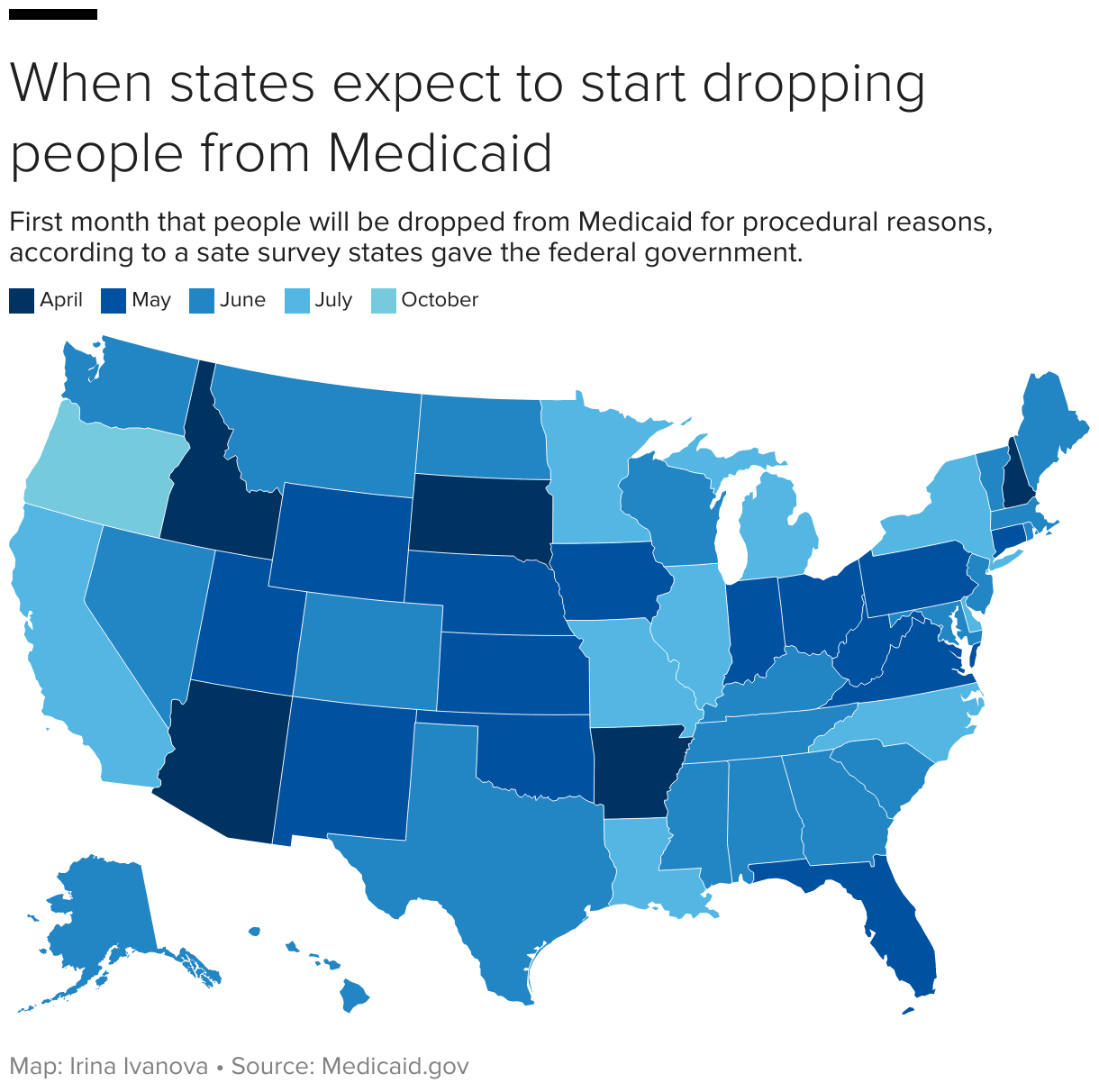
Some states have already started the disenrollment process. The Associated Press reported that no-longer-eligible Medicaid members could be removed as soon as April in these nine states: Arizona, Arkansas, Florida, Idaho, Iowa, New Hampshire, Ohio, Oklahoma and West Virginia.

But not all ineligible people will be dropped from the program at once, as states have set different timelines for re-checking eligibility of Medicaid patients. Most states are expected to take between nine months and a full year to complete the verification process.

How are states notifying people being about losing Medicaid?

As recently as December, two-thirds of adults in Medicaid households weren’t aware that the program rules were changing, according to a survey from the Robert Wood Johnson Foundation.

“Unfortunately we’re going to see it in real time, with children and people losing coverage simply because people are unaware of what’s happening,” Taverna said. 

“That’s the concern, that people will go without coverage for months and then go through bureaucracy and red tape to have to reenroll.” 


Bill of the Month: Woman mistakenly charged for shoulder surgery she never had

05:48

Health care advocates are urging people on Medicaid to update their contact information, including their home address, phone number and email, with the state.

If you rely on Medicaid, states will mail a renewal form to your home. The federal government also requires states to contact you in another way -– by phone, text message or email –- to remind you to fill out the form.

“A text might just grab someone’s attention in a way that would be more accessible,” said Kate McEvoy, executive director of the nonprofit National Association of Medicaid Directors. 

While most states have already used texting for reminders to get a COVID-19 vaccine or attend an upcoming doctor’s visit, sending mass texts on Medicaid eligibility will be new, McEvoy said.

You will have at least 30 days to fill out the form. If you do not fill out the form, states will be able to remove you from Medicaid.

What options do people have if they lose Medicaid?

Some of those who won’t qualify for Medicaid coverage will be able to get health insurance from the  Affordable Care Act’s marketplace for coverage, where private coverage subsidized by federal tax credits can cost as little as $10 a month, depending on a person’s income. 

A special enrollment period for people dropped from Medicaid starts March 31 and will last through July 31, 2024, the Centers for Medicare and Medicaid Services said in January. People who lose Medicaid coverage can submit an application at any time during that period after losing coverage and will have up to 60 days to select their plans, CMS said. 

It noted that consumers don’t need to wait until their Medicaid ends to apply for new coverage, but can start applying 60 days before their Medicaid is scheduled to end. 

Still, coverage through the Obamacare marketplace or through an employer is often vastly different from what Medicaid offers. 

“Even on employer-sponsored plans, copays and out-of-pocket costs may be higher than Medicaid, and that makes it unaffordable,” Taverna said. 

People changing coverage will also need to check that their new insurance plans will still cover their doctors.


Business analyst Jill Schlesinger discusses health insurance options during open enrollment

05:00

What happens to kids enrolled in Medicaid?

More than half of U.S. children receive health care coverage through Medicaid or the Children’s Health Insurance Program. But even if an adult loses Medicaid coverage, it doesn’t mean their kids will. 

Even if you receive a notice that you’re no longer eligible for Medicaid, it’s likely that your child still qualifies for the program or for health care coverage through CHIP. CHIP covers children whose families make too much money to qualify for Medicaid but don’t earn enough to afford private health insurance.

Between 80% and 90% of children will still be eligible for those programs, according to estimates from the Georgetown University Health Policy Institute’s Center for Children and Families.

“When a parent receives a message that they aren’t eligible anymore, they often assume their child is no longer eligible either,” Joan Alker, the center’s executive director, told the Associated Press. “It’s more common to find that the parent is no longer eligible for Medicaid, but the child still is.”

The Associated Press contributed reporting.


Source link

source https://financetin.com/medicaid-raid-millions-of-americans-are-about-to-lose-coverage-heres-what-to-know/financetin.com