This is default featured slide 1 title

Go to Blogger edit html and find these sentences.Now replace these sentences with your own descriptions.This theme is Bloggerized by Lasantha Bandara - Premiumbloggertemplates.com.

This is default featured slide 2 title

Go to Blogger edit html and find these sentences.Now replace these sentences with your own descriptions.This theme is Bloggerized by Lasantha Bandara - Premiumbloggertemplates.com.

This is default featured slide 3 title

Go to Blogger edit html and find these sentences.Now replace these sentences with your own descriptions.This theme is Bloggerized by Lasantha Bandara - Premiumbloggertemplates.com.

This is default featured slide 4 title

Go to Blogger edit html and find these sentences.Now replace these sentences with your own descriptions.This theme is Bloggerized by Lasantha Bandara - Premiumbloggertemplates.com.

This is default featured slide 5 title

Go to Blogger edit html and find these sentences.Now replace these sentences with your own descriptions.This theme is Bloggerized by Lasantha Bandara - Premiumbloggertemplates.com.

Wednesday, December 14, 2022

China accepts “no way to keep track” of COVID cases amid shift from eradication strategy to “treatment”

https://ift.tt/2VXx6C5

Beijing — A week after China’s health authorities sparked chaos and confusion by announcing sweeping changes to the country’s draconian COVID-19 control measures, the government’s coronavirus czar has tried to bring some clarity about the new strategy. In doing so, China’s government has admitted for the first time that it’s impossible to try and detect and track every case of the coronavirus. 

Many across China, but particularly in the immense capital city of Beijing, have been desperate for more information given an anecdotal rise in sickness that doesn’t seem to match up with official case counts, which have suggested a drop in the spread of the virus.

As of one week ago China has been allowing people infected with COVID-19 to quarantine at home with asymptomatic or mild cases, and it has dropped the requirement for everyone to show a recent negative test result before entering most public places.

Virus Outbreak China
A woman tends to a child at a fever clinic at a children’s hospital in Beijing, December 14, 2022.

Dake Kang/AP


The abrupt U-turn in the country’s strict “zero-COVID” policy came after rare public protests against the measures, but what replaced the long-standing rules — and the stern rhetoric about the dangers of catching COVID-19 — was a lack of clear guidance that led to a rush on everything from cold and flu medicines to at-home test kits.

Visiting hospitals on Tuesday, China’s top official on the coronavirus, Vice Premier Sun Chunlan, explained that the country’s focus should shift from “preventing infections” to “medical treatment” of those suffering with the virus. The very clear goal of the last three years, in other words, of quickly isolating and stamping out any infections at all, has been changed to preventing and treating severe cases.

CHINA-BEIJING-SUN CHUNLAN-INSPECTION (CN)
Chinese Vice Premier Sun Chunlan inspects the Capital Institute of Pediatrics in Beijing, China, December 13, 2022, amid the ongoing COVID-19 pandemic. 

Yan Yan/Xinhua/Getty


As part of the new strategy, which broadly reflects the policies adopted many months ago by many other major economies, China’s National Health Commission announced Wednesday that it would no longer report the number of asymptomatic cases in the country. With the mandatory mass-testing that had impeded everyday life for years now officially abandoned, the commission said there was “no way to keep track of actual numbers” of infections.

The announcement was added without fanfare as a note on the health service’s daily report of COVID cases — and the recent downward trend reflected in that report may be largely explained by the sudden, massive drop in testing. Official caseloads have been declining steadily since late November, but anecdotal evidence from Chinese social media suggests many people are still catching the virus.

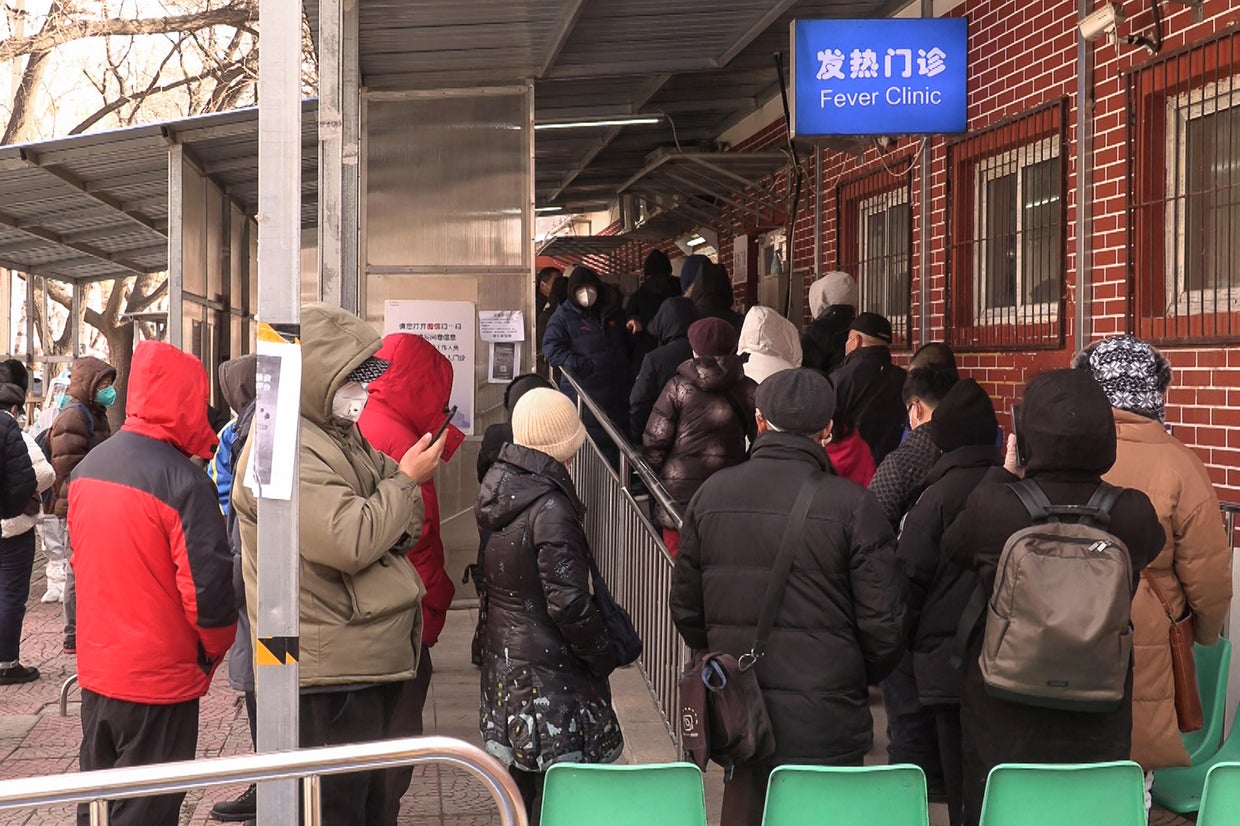
For days, “fever clinics” around the Chinese capital have had lines of people waiting outside in the cold for COVID tests or treatment for hours. Common cold, flu and pain medicines and the rapid at-home antigen test kits are in extremely short supply. Demand for the tests has soared as many of the government-run PCR test booths that became regular fixtures across Chinese cities during the last few years have been dismantled over the last couple weeks.
CHINA-HEALTH-VIRUS
People line up outside a fever clinic in Beijing, China, to seek testing and treatment amid the ongoing COVID-19 pandemic, December 14, 2022.

YUXUAN ZHANG/AFPTV/AFP/Getty


On Saturday, Beijing’s emergency services received six times as many calls as usual. On Sunday, the number of people visiting the capital’s fever clinics spiked to 16 times the usual level.

The general public have not been alone in struggling to adjust to the new strategy. The National Bureau of Statistics cancelled its regularly scheduled monthly news conference this week, saying it would instead release COVID case data online. Taiwanese media pointed out that Beijing’s office in charge of relations with the democratically governed island had canceled two consecutive media briefings.

One of the biggest problems for China as it eased its tight anti-virus rules was the relatively low proportion of the country’s vast, 1.4 billion-strong population who have been fully vaccinated and boosted against COVID-19. Chinese authorities declined for years to use Western-developed vaccines, sticking with the country’s domestic products which didn’t perform as well during clinical trials.

Of particular concern, many older Chinese citizens remain un- or under-vaccinated, though the government did announce a major vaccination push when it dropped the zero-COVID policy last week.

There was a new glimmer of hope this week, however, as a domestic healthcare app started selling Pfizer’s COVID-19 treatment PAXLOVID to anyone with a positive test result. Even at $426.80 per box, the medicine reportedly sold out on the app within half an hour.

CBS News’ Tucker Reals contributed to this report. 


Source link

source https://financetin.com/china-accepts-no-way-to-keep-track-of-covid-cases-amid-shift-from-eradication-strategy-to-treatment/financetin.com

States challenge Biden to lower drug prices by allowing imports from Canada

https://ift.tt/2VXx6C5

The Biden administration is facing mounting pressure from states to let them import medicine from Canada to help lower prescription drug costs.

Colorado on Dec. 5 became at least the fourth state to seek federal permission to use the strategy, following Florida, New Hampshire, and New Mexico. President Biden has endorsed the approach, but his administration has yet to greenlight a state plan.

“States have done the work, and the only thing preventing them from going ahead is the Biden administration,” said Jane Horvath, a health policy consultant who has worked with states on importation plans.

U.S. Health and Human Services Secretary Xavier Becerra told KHN on Dec. 5 that the Biden administration welcomed applications for drug importation programs from Colorado and other states. But he would not pledge that the FDA would rule on any application in 2023.

Asked what his message was to states, he said: “Sign up and submit an application, and we will take a look and see if you are able to get through the process.”

Stall tactics?

Americans pay among the highest prices in the world for brand-name pharmaceuticals. Drugs are generally less expensive in neighboring Canada, where the government controls prices.

Under former President Donald Trump, the U.S. government declared that importing drugs from Canada could be done safely — satisfying a condition spelled out in a 2003 federal drug importation law. The Trump administration finalized rules in September 2020 for states to apply.

During his campaign for the White House, Mr. Biden said he would allow consumers to import prescription drugs from other countries if the federal government certified those drugs as safe.

After Mr. Biden took office in 2021, he ordered the FDA to work with states to import prescription drugs from Canada. In a speech last year about how he was going to reduce drug prices, he cited estimates by Colorado about how much money people in the state could save through importation.

Despite the administration’s public show of support, early applicants have been frustrated by the FDA’s inaction.

In August, almost two years after submitting its drug proposal, Florida sued the federal government, accusing the Biden administration of slow-walking its review. The federal government denied the accusation. Florida Gov. Ron DeSantis, a potential Republican presidential contender for 2024, has championed the state’s effort.

In November, about three months after Florida sued, the FDA sent Florida a 15-page letter asking it to fill dozens of gaps in its plan. The letter asked whether the state wanted to withdraw its application and submit another.

In a December court filing, Florida said “suddenly conjuring so many supposed defects” in its proposal was another “stall tactic” by the government.

New Hampshire Health and Human Services Department spokesperson Jake Leon said New Hampshire’s proposal was rejected because it did not identify a Canadian wholesaler that would provide the drugs. He said the FDA told the state it could reapply when it found one.

New Mexico remains in discussions with the FDA, said David Morgan, a state Health Department spokesperson.

Other states have signaled interest in importation but have yet to seek federal approval.

Drug industry opposition

The drug industry, wary that a government-organized importation program could eat into its profits, opposes the strategy and has argued it would circumvent controls that keep drugs safe in the U.S.

The Pharmaceutical Research and Manufacturers of America, the drug industry lobby known as PhRMA, sued the federal government in 2020 to block drug importation. That lawsuit is still pending. The Biden administration has argued in court that the lawsuit is invalid because it’s unclear when, if ever, the administration would approve a state’s importation plan.

Many brand-name drugs sold in the U.S. are already made abroad. In addition, millions of Americans have purchased lower-priced drugs from Canada and overseas through online pharmacies and by visiting other countries.

Colorado officials said their proposal aims to save residents and employers an average of 65% off the cost of dozens of medications, including drugs for diabetes, asthma, and cancer.

Kim Bimestefer, executive director of the Colorado Department of Health Care Policy & Financing, told KHN the state wants to disrupt the current drug pricing system in which manufacturers can charge as much as the market will bear. The FDA told state officials it would take the agency six months to review its proposal, she said.

Colorado’s proposed plan would use an Ontario, Canada, wholesaler to send drugs through the border at Buffalo, New York, to an importer headquartered in Boise, Idaho. The drugs would be tested by an Ohio laboratory before being sent to pharmacies in Colorado and then sold to residents and employers.

Colorado will add safety checks for drugs brought in from Canada that go beyond those for drugs sold in the United States, Bimestefer said. “We are highly confident of their quality and bullish on the savings,” she said of the Canadian drugs.


How the U.S. generic drug supply chain works

02:52

Colorado’s application said the state’s importation strategy faces not only resistance from drug manufacturers but also concerns on the part of pharmacies and the Canadian government.

Canadian officials have opposed U.S. import plans because they fear the efforts could lead to drug shortages in Canada. However, Bimestefer said Colorado would bring in drugs only if ample supply exists for both countries.

The Colorado Business Group on Health, which includes large employers, strongly favors importation but realizes the Biden administration is under pressure from groups that profit from the status quo, said Robert Smith, the coalition’s executive director. He called concerns about patient safety a “red herring.”

“The one thing we know about health care is that it is driven by economic self-interests,” he said.

KHN (Kaiser Health News) is a national newsroom that produces in-depth journalism about health issues. Together with Policy Analysis and Polling, KHN is one of the three major operating programs at KFF (Kaiser Family Foundation). KFF is an endowed nonprofit organization providing information on health issues to the nation.

Subscribe to KHN’s free Morning Briefing.


Source link

source https://financetin.com/states-challenge-biden-to-lower-drug-prices-by-allowing-imports-from-canada/financetin.com

Tuesday, December 13, 2022

Moderna and Merck report progress on potential skin cancer vaccine

https://ift.tt/2VXx6C5

Moderna’s stock soared Tuesday after the COVID-19 vaccine maker detailed progress in developing a preventive shot for a deadly form of skin cancer.

The company said a possible melanoma vaccine it is studying with pharmaceutical giant Merck fared well in a small study of patients who had the cancer surgically removed.

The drugmakers said a combination of the vaccine and Merck’s immunotherapy Keytruda led to a statistically significant improvement in survival before the cancer returned in patients with advanced melanoma.

“We are very excited, we are moving very quickly with Merck onto phase 3 for this study,” Moderna CEO Stephane Bancel told CNBC Tuesday morning.

Phase 3 is generally the largest and most expensive stage of clinical research before regulators review a potential drug for approval.

Moderna developed one of the most popular vaccines used to protect patients against COVID-19, and the drugmaker brought in more than $3 billion from its Spikevax in this year’s third quarter.

But vaccine use has slowed, and Moderna depends on Spikevax for nearly all its revenue.

Like Spikevax, the potential skin cancer vaccine uses mRNA technology. It trains a patient’s immune system to recognize and respond specifically to mutations in the DNA of the patient’s tumor.

In a mid-stage clinical trial involving 157 patients, researchers compared the vaccine-Keytruda combination with Keytruda alone.

Keytruda, Merck’s top seller, primes the body’s immune system to detect and fight tumor cells. Regulators have approved it to treat several types of cancer.

The patient group that took the potential vaccine and Keytruda saw a 44% reduction in the risk of death or the cancer returning, the companies said.

The treatments continued for about a year in both groups unless the disease came back or side effects became too severe.

Merck and Moderna expect to start a phase 3 study next year, and the companies say they intend to expand their approach to other tumor types.

Merck and Moderna established an agreement to work together in 2016, and the companies plan to share costs and profits in their collaboration. Merck also paid Moderna $250 million.

Shares of Cambridge, Massachusetts-based Moderna Inc. soared 23% to top $200 in midday trading while broader indexes climbed. Kenilworth, New Jersey-based Merck & Co. climbed less than 1%.


Source link

source https://financetin.com/moderna-and-merck-report-progress-on-potential-skin-cancer-vaccine/financetin.com

Need an ambulance? Depending on the state, it will cost you

https://ift.tt/2VXx6C5

Although the U.S. outlawed most surprise medical bills starting this year, people who face a health emergency could still find themselves on the hook for hundreds of dollars — or more — in out-of-network fees.

For patients with health insurance, an ambulance ride can set someone back between $500 and $1,000, according to a report from the Public Interest Research Group released Tuesday.

“Ground ambulances are the highest out-of-network biller of all of our health care services,” Patricia Kelmar, PIRG’s senior director of health care campaigns, told CBS MoneyWatch. 

Some 3 million patients go to the hospital in an ambulance each year, more than half of whom will end up with a surprise bill, according to the consumer advocacy group. One study found that between 2010 and 2016, 85% of ambulance patients were hit with a surprise bill for out-of-network services, also known as a balance bill.

The size of the bill can vary tremendously among states. In Washington, D.C., for example, the median surprise ambulance bill is just $37, according to a study published in Health Affairs in 2020. 

By contrast, patients in California, Massachusetts and Minnesota can expect to pay over $1,000 out of pocket for an ambulance ride, after whatever costs their insurance provider covers. In California, the median bill for an ambulance ride is about $1,200, while in Massachusetts it’s $1,024 and $1,133 in Minnesota.

Patchwork system

One reason for the disparity in ambulance billing is the proliferation of different types of ambulance services. Modern ambulance networks were established in the 1970s thanks to a major federal push and dedicated funding. But after congressional money dried up in the 1980s, states took over and many programs were cut or privatized, Kelmar said.

“Different communities responded in different ways,” she said. “Some municipalities set up funding programs [for ambulance services], some got absorbed into fire departments, some hospitals started ambulance services and private services started up as well.” 

In recent years, private equity firms have also taken over ambulance services — a change in ownership that often results in aggressive billing and debt collection, PIRG noted. There are about 14,000 different ambulance services around the county, Kaiser Health News has estimated.

Patients are also more likely to be stuck with surprise ambulance bills in certain states. For instance, Maryland bars volunteer ambulances, or those owned by the local government or fire department, from billing patients. Only half of ambulance rides in Maryland result in a surprise bill, according to the Health Affairs study, which looked at patients in a large national health insurance plan. 

On the other end of the spectrum, 93% of ambulance rides in Oregon and nearly 90% of those in Washington state result in a surprise bill, the study found. 

Altogether, 10 states have laws to limit balance billing for ambulance rides, but even those protections have large gaps. Most notably, they leave out the 60% of insured Americans whose health care is covered by self-funded large insurer plans. 

“Roll of the dice”

Unlike a patient who schedules a doctor’s visit and can check if those medical services are within their health insurance network, someone calling 911 for a medical emergency has no such ability. Ambulance patients often may not know who operates the transport service. 

“You’re not going to consult a directory when you’re dialing for an ambulance,” Kelmar said.  “Of course, when you call 911, they’re just dispatching the closest available ambulance …. It’s a roll of the dice if you’ll get that out-of-network bill.”


New research: 100 million Americans face health care debt

02:29

PIRG is pushing Congress to include ambulance bills in the recently passed No Surprises Act, which protects patients in emergency situations from being billed for out-of-network services they didn’t agree to. While the law doesn’t regulate ambulances, it has directed a committee to study the issue and make recommendations. 

“We have figured out how to solve surprise billing with the No Surprises Act. It’s working, and people aren’t having to face those bills they couldn’t avoid. Ground ambulances are the same thing,” Kelmar said. “We shouldn’t be price-gouging those unlucky few who have an emergency.”


Source link

source https://financetin.com/need-an-ambulance-depending-on-the-state-it-will-cost-you/financetin.com

Vaccine choice law in healthcare settings struck down

https://ift.tt/2VXx6C5

HELENA, Mont. — A person’s choice to decline vaccinations does not outweigh public health and safety requirements in medical settings, a federal judge ruled in a Montana case.

U.S. District Judge Donald Molloy last week permanently blocked a section of law the state said was meant to prevent employers — including many healthcare facilities — from discriminating against workers by requiring them to be vaccinated against communicable diseases, including COVID-19.

“The public interest in protecting the general populace against vaccine-preventable diseases in health care settings using safe, effective vaccines is not outweighed by the hardships experienced to accomplish that interest,” Molloy concluded in his Dec. 9 ruling.

The Montana Legislature passed the first-in-the-nation law in 2021, about a year into the pandemic as some people, businesses and Republican lawmakers were pushing back on healthcare measures enacted to prevent the spread of the virus that has now killed more than 1 million people in the United States. Just over 3,600 Montana residents have died from COVID-19, state officials say.

Not a Modern Healthcare subscriber? Sign up today.

The Montana law made it illegal for a person to be denied services, goods or employment based on their vaccine status. The law did not change vaccine requirements at schools or daycare facilities or eliminate a person’s right to seek a religious or medical exemption.

Republican lawmakers who supported the bill said it was needed in response to employers threatening to fire workers who would not get vaccinated.

Before signing the bill, Republican Gov. Greg Gianforte asked lawmakers to amend it to allow long-term care facilities to require workers to receive COVID-19 vaccines if failing to do so meant the facility could lose funding under a federal directive.

The federal directive was recently challenged by attorneys general in 22 states including Montana.

The Montana Medical Association, clinics and immunocompromised patients filed a lawsuit against the state in September 2021 and were later joined by the Montana Nurses Association. They argued, and Molloy agreed, that treating clinics and hospitals differently from long-term care facilities made no sense for a law that the state said was meant to prevent discrimination and protect private health care information.

The plaintiffs argued that in some cases, the same people can work in all three types of facilities on the same day.

Download Modern Healthcare’s app to stay informed when industry news breaks.

The plaintiffs successfully argued that the law violates the Americans With Disabilities Act, which requires public facilities to make reasonable accommodations for people with disabilities. An immunosuppressed patient would be vulnerable if they were treated at a healthcare facility where the employees were not vaccinated, Molloy found.

The law also violated the federal Occupational Health and Safety Act by failing to keep the workplace free from recognized hazards, he said. The plaintiffs proved that vaccine-preventable diseases constitute recognized hazards in healthcare settings, Molloy wrote.

“The Court’s order is a win for all Montanans — young or old, healthy or sick — who no longer need to worry about government interference with the safety of their healthcare in Montana,” Vicky Byrd, CEO of the Montana Nurses Association, said in a statement.

Montana Attorney General Austin Knudsen is studying the opinion to determine his next steps, spokeswoman Emilee Cantrell said in a statement.

In the meantime, Knudsen is leading a group of attorneys general challenging the federal Centers for Medicare & Medicaid Services mandate that healthcare workers in long-term care facilities be vaccinated against COVID-19. The challenge argues the vaccine does not prevent the spread of the virus, breakthrough infections are common and that the vaccines themselves are not entirely risk-free.


Source link

source https://financetin.com/vaccine-choice-law-in-healthcare-settings-struck-down/financetin.com

Thursday, December 8, 2022

Juul Agrees to Settle Thousands of Vaping Lawsuits

https://ift.tt/gQRG27D


The deal is the latest in the company’s efforts to resolve litigation over its marketing of products that some contend fueled the teenage vaping crisis.


Source link


source https://financetin.com/juul-agrees-to-settle-thousands-of-vaping-lawsuits/financetin.com

Thursday, December 1, 2022

Poem: (Intuitions. She)

https://ift.tt/RoMTzip


Coral Bracho depicts the terror of Alzheimers — losing yourself within a formerly capable and operating mind and body.


Source link


source https://financetin.com/poem-intuitions-she/financetin.com