Go to Blogger edit html and find these sentences.Now replace these sentences with your own descriptions.This theme is Bloggerized by Lasantha Bandara - Premiumbloggertemplates.com.
Go to Blogger edit html and find these sentences.Now replace these sentences with your own descriptions.This theme is Bloggerized by Lasantha Bandara - Premiumbloggertemplates.com.
Go to Blogger edit html and find these sentences.Now replace these sentences with your own descriptions.This theme is Bloggerized by Lasantha Bandara - Premiumbloggertemplates.com.
Go to Blogger edit html and find these sentences.Now replace these sentences with your own descriptions.This theme is Bloggerized by Lasantha Bandara - Premiumbloggertemplates.com.
Go to Blogger edit html and find these sentences.Now replace these sentences with your own descriptions.This theme is Bloggerized by Lasantha Bandara - Premiumbloggertemplates.com.
In a world where things are constantly changing and uncertainty has become our anthem, it’s nice to have some stability. Inflatable standup paddleboards offer just that. While many businesses and restaurants have been closing during these trying times, the SUP industry is booming and inflatables are flying off the shelves.
Although many inflatables feature similar dimensions and construction technologies, there are a number of unique boards on the market. Here, we’ve rounded up six of our favorite inflatable standup paddleboards, with something for everyone—regardless of where you paddle.
One of the biggest benefits of inflatables is that they easily allow you to explore and travel the world. Starboard’s Vision Inflatable takes things a step further by giving you a glimpse of what lies beneath the surface.
The board features the world’s first underwater viewing window, a full EVA deck pad, nose and tail bungee tie-down straps, and a deluxe single chamber construction. Measuring 11’2” x 38”, the board is incredibly stable and well-suited for exploring with the entire family in tow.
In an effort to combat the hassle of lugging around an oversized standup paddleboard on surf trips, Red Paddle Co. created an inflatable SUP designed specifically for surfing. Although surfing on an inflatable may seem counterintuitive, the 8’10” x 29” Whip is rigid, durable, and stable.
Standout features include a narrow tail, an embossed deck pad, a rounded nose, and Red Paddle Co.’s patented RSS batten system––which makes the board incredibly rigid. The board includes a double chamber pump, an adjustable fin, and an all terrain backpack, complete with padded straps and integrated wheels.
Storing, transporting, and traveling with a raceboard can be a challenge. Although hard boards are still the fastest option out there, NSP’s O2 Race FSL holds its own.
Featuring double layer rail construction with double sealing rail bands, a low-profile Air7 V3 fin box, and a thermoformed EVA deck pad––the board is sleek, stable, and fast. Available in four size options, the Race FS includes a 9” center race.
The Body Glove Performer is a one-size-fits-all inflatable that’s equipped for any and every adventure. Made from heavy-duty PVC and measuring in at 11’ x 34”, the board is super stable, making it well-suited for paddling with pets, practicing yoga, fishing, or a casual paddle through the harbor.
New for 2020, the board features 30% more surface area on the fixed fins, triple-layered side rails, upgraded carbon-reinforced stringers, and a 13.7 cm/5.4” drop-stitch––resulting in an overall lighter board. Included in the package are a three-piece adjustable paddle, dual-action hand pump, ankle coil leash, phone dry bag, repair kit, and a travel backpack.
Measuring 11’ x 33” x 6”, the BOGA Yoga Air is ultra-wide and stable, allowing yogis to take their practice to the water. In order to ensure the board is sturdy, stiff, and responsive, it is crafted from 6” non-linear drop stitch core material and includes a high tensile uni-directional stringer.
Featuring BOGA’s beautiful signature deck mat, nose and tail anchor points, a single fin, and tie-down straps on the nose––the Yoga Air is ideal for on-the-water fitness workouts and any yoga pose you can do.
Measuring in at 11’6” x 32” x 6”, the Isle Explorer was thoughtfully designed with explorers and adventure seekers in mind. Available in two color options, the board features a pointed nose, which is ideal for long, fast-paced flatwater paddles.
Additionally, the Explorer features a front and rear bungee system for stashing gear, nose and tail grab handles, a rounded carry handle, a grooved EVA traction pad, a paddle holder, center and tail D-rings, and a high-pressure valve. The package includes a coil leash, a nylon touring fin, three-piece adjustable paddle, a hand-pump, and a travel bag.
If you’re searching for that extra kick-in-the-seat to get through your treadmill session, try music. Not just any music though: Listening to faster-tempo tunes between 170 and 190 beats per minute (bpm) was found to have the greatest effect on getting people’s heart rate up while lowering their perceived effort, according to a recent study by Andrea De Giorgio, associate professor in physiological psychology at eCampus University in Italy.
During the experiment, people worked out in silence or with slow, medium, or fast-paced music. Overall, the faster the beat, the easier the workout felt, which is key since research shows that the limiting factor in people’s workouts is usually mental, not physical. “Rhythmic patterns of music facilitate the execution of movement, creating a feedback loop,” says De Giorgio. “In the context of exercise, certain music can be strategically chosen in order to induce physio-psychological responses that lead to better performance, as well as regulating mood and shifting attention. Try “Go Off” by M.I.A. (170 bpm), “Arabesque” by Coldplay (172 bpm), and “Follow God” by Kanye West (180 bpm).
To say we’re living through challenging times sounds like both a cliché and an understatement. In recent months, news about the pandemic, economic woes, and bitter political debates have triggered tremendous anxiety and sadness for many Americans.
But when people look back on their lives, it is usually the most difficult challenges that gave them a new perspective or caused them to grow the most. Of course, in the midst of a crisis, it doesn’t feel that way. But there are steps you can take to cope during difficult times, using techniques from the field of positive psychology.
How can positive psychology help in trying times?
Initially, positive psychology focused mainly on pursuing rewarding experiences that made people feel more joyful. But psychologists soon realized this sort of happiness depends on fleeting experiences, rather than a more enduring sense of contentment. As a result, the field shifted to concentrate on cultivating satisfaction and well-being but staying open to the full range of emotional experiences, both good and bad. Contrary to what you might expect, trying to resist painful emotions actually increases psychological suffering.
“Positive psychology is not about denying difficult emotions. It’s about opening to what is happening here and now, and cultivating and savoring the good in your life,” says Ron Siegel, PsyD, assistant professor of psychology at Harvard Medical School.
If you develop the habit of counting your blessings, for example, you may be better able to appreciate the positive aspects of life that remain even after a painful event like a job loss or a death. And helping others, even when you are struggling, can increase your positive feelings and help you gain perspective.
Growing evidence suggests that positive psychology techniques can indeed be valuable in times of stress, grief, or other difficulties. They may also help you develop the resilience to handle difficulties more easily, and bounce back more rapidly after traumatic or unpleasant events. Here are three positive psychology practices you can try.
Be more mindful
Mindfulness is the practice of purposely focusing your attention on the present moment and accepting it without judgement. Learning to live more in the present is especially helpful when the future is uncertain. Formal mindfulness-based stress reduction programs have been shown to help reduce physical and psychological symptoms in people facing a variety of challenges, including cancer and chronic pain. To practice at home, you can try some of the free guided recordings of mindfulness meditations narrated by Dr. Siegel, available at www.mindfulness-solution.com.
Share some kindness
Research suggests that people who volunteer their time tend to be happier than those who don’t. Those who give charitable donations may even get a small mood boost. Try this exercise: When you have a free afternoon, flip a coin. Heads, do something self-indulgent (for instance, give yourself a manicure). Tails, do something to help your community or another person (for example, call or write to an elderly person). Notice how you feel at the time and in the hours and days that follow.
Practice gratitude
Gratitude is a thankful appreciation for what you receive, whether tangible or intangible. With gratitude, you acknowledge the goodness in your life. You can apply this to your past (by retrieving positive memories and being thankful for elements of your childhood or past blessings), the present (not taking things for granted as they come), and the future (being hopeful and optimistic that there will be good things arriving). Our brains are wired to take note of when things go wrong. But keeping a gratitude journal — writing down things you’re thankful for — makes you more aware of when things go right.
Survival rates among Black and Hispanic patients were at least as good as those for white patients after the researchers controlled for age, sex, income levels and pre-existing conditions, according to the study.
from WebMD Healthhttps://img.webmd.com/dtmcms/live/webmd/consumer_assets/site_images/article_thumbnails/other/medical_equipment_covid19_other/1800x1200_medical_equipment_covid19_8_other.jpg https://ift.tt/30ro7Oh
via IFTTT
Deaths related to alcohol use in those regions rose 43% between 2006 and 2018, health officials reported.
from WebMD Healthhttps://img.webmd.com/dtmcms/live/webmd/consumer_assets/site_images/article_thumbnails/reference_guide/what_is_alcohol_abuse_ref_guide/1800x1200_what_is_alcohol_abuse_ref_guide.jpg https://ift.tt/3iizo9t
via IFTTT
Choline is an often-overlooked nutrient — so overlooked that it wasn’t until 1998 that the Institute of Medicine officially recognized it as an essential nutrient.1 Choline has many roles in human metabolism and is involved in everything from cell structure to the synthesis of neurotransmitters.
Choline is necessary for cell-membrane signaling, the transport of lipids and methyl-group metabolism, which is involved in detoxification. During development, choline is essential for the brain and memory in the fetus and decreases the risk of neural tube defects.2
A deficiency in choline may contribute to liver disease, atherosclerosis and neurological disorders, and its importance continues through adulthood and into old age.
While choline is found in a variety of foods, intakes for adults and children are believed to be far below optimal levels, putting public health at risk and leading experts to suggest that [intake of choline-rich foods should be encouraged.3 Among them, krill oil may be superior, due to its unique phospholipids.4
Why Krill Oil Is an Ideal Source of Choline
Norwegian researchers conducted a study looking into the use of phosphatidylcholine from krill oil to counteract the drop in choline that often occurs among athletes competing in triathlons. Choline plays a role in normal muscle function, and it’s known that the concentration of free choline may decrease during long distance high-intensity exercise.5
Krill oil contains 69 choline-containing phospholipids to synthesize phosphatidylcholine, a critical component of human cell membranes.6 This is key to its benefits as a source of choline, because it’s estimated that 60% of choline in organic salts is otherwise lost when gut bacteria convert it to the metabolite trimethylamine (TMA).
Enzymes may then turn TMA into trimethylamine-N-oxide (TMAO), a potential biomarker for insulin resistance and heart problems. Krill oil, however, contains fatty acids in the form of phosphatidylcholine (PC) — unlike fish oil, which contains them in triglyceride form.
As noted by the researchers, “Choline in the form of PC is considerably less converted to TMA as demonstrated in a single-dose study with krill oil,7 potentially resulting in more efficient delivery of choline.”8 It’s been shown for instance, that 28 days of krill oil supplementation increased choline levels in healthy young adults.9
Krill Oil May Protect Choline Status in Athletes
Writing in the journal Frontiers in Nutrition, researchers set out to determine if supplementing with phosphatidylcholine from krill oil prior to a triathlon would counteract the expected drop in choline during the race.10 For the study, 24 athletes received either 4 grams of krill oil or 4 grams of mixed vegetable oil daily for five weeks prior to the race.
Blood samples to assess choline and its metabolites were taken before, immediately after and the day after the race. Choline concentrations significantly declined from before the race to after among the athletes, but those in the krill oil group had significantly higher concentrations of choline compared to the vegetable oil group, and also had a significantly greater increase in choline after the race was completed.
“In conclusion,” the researchers noted, “krill oil may help to prevent that circulating choline concentrations become limiting during endurance competitions.”11 However, it’s not only athletes who may benefit from the choline krill oil provides, especially considering that a National Health and Nutrition Examination Survey found that 90% of the U.S. population had inadequate choline intake.12
Risks of Choline Deficiency
Choline is a nutrient that’s important throughout life. Among adults deprived of choline, 77% of men and 80% of postmenopausal women developed fatty liver or muscle damage — signs of organ dysfunction — as did 44% of premenopausal women.13 When incremental amounts of choline were added back into their diets, normal organ function was restored. As noted by researchers in the journal Nutrition Reviews:14
“Because of its wide-ranging role in human metabolism, from cell structure to neurotransmitter synthesis, choline deficiency is now thought to have an impact on diseases such as nonalcoholic fatty liver disease, atherosclerosis (via lipoprotein secretion), and possibly neurological disorders. Therefore, getting adequate choline in the diet is important throughout life for optimal health.”
Some of the symptoms associated with low choline levels include memory problems, lethargy and persistent brain fog. Choline also prevents the buildup of homocysteine in your blood, which is important since elevated levels are linked to heart disease, cancer, cognitive decline and bone fractures.15
Choline also reduces chronic inflammation, and research shows that people with choline-rich diets have lower levels of inflammatory markers such as C-reactive protein, homocysteine, interleukin-6 and tumor necrosis factor.16 Meanwhile, choline deficiency is linked with DNA damage and apoptosis, and breast cancer risk may be reduced by 24% among women who eat a high-choline diet.17
Choline for Brain and Liver Health
Choline has also been implicated in the risk of dementia,18 may improve cognitive performance19 and low levels are associated with increased anxiety levels.20 It’s believed that choline may help to support the structural integrity of neurons, benefitting brain function in the elderly, and may even reduce the progression of dementia in people with Alzheimer’s disease.21
Further, without choline a range of your body’s metabolic processes will be seriously affected. According to the U.S. National Institutes of Health:22
“The body needs choline to synthesize phosphatidylcholine and sphingomyelin, two major phospholipids vital for cell membranes. Therefore, all plant and animal cells need choline to preserve their structural integrity.
In addition, choline is needed to produce acetylcholine, an important neurotransmitter for memory, mood, muscle control, and other brain and nervous system functions. Choline also plays important roles in modulating gene expression, cell membrane signaling, lipid transport and metabolism, and early brain development.”
A deficiency in choline can also lead to liver damage, including nonalcoholic fatty liver disease (NAFLD or hepatosteatosis). Because choline is involved in fat metabolism, low levels of the nutrient can result in an overaccumulation of deposits of fat in your liver.23
Not only have studies found that risk of NAFLD increases with lower dietary choline intake, but the risk of NAFLD was found to be 32% lower in women, and 25% lower in men, with the highest choline intakes compared to those with the lowest.24
Are You Getting Enough Choline?
A Dietary Reference Intake (DRI) has not been established for choline, but the Institute of Medicine set an adequate daily intake value for men, women and children. The daily values are 425 milligrams (mg) per day for women, 550 mg for men and 250 mg for children as a minimum amount to prevent choline deficiency and potential organ damage.
However, requirements may vary depending on your overall diet, genetic makeup and other lifestyle factors. Groups at particularly high risk for choline deficiency include pregnant mothers, endurance athletes, postmenopausal women, vegans and those who consume high amounts of alcohol. Here's a further breakdown from the National Institutes of Health:25
Age
Male
Female
Pregnant Women
Nursing Women
0 to 6 months
125 mg/day
125 mg/day
7 to 12 months
150 mg/day
150 mg/day
1 to 3 years
200 mg/day
200 mg/day
4 to 8 years
250 mg/day
250 mg/day
9 to 13 years
375 mg/day
375 mg/day
14 to 18 years
550 mg/day
400 mg/day
450 mg/day
550 mg/day
19 years and older
550 mg/day
425 mg/day
450 mg/day
550 mg/day
While your liver makes a small amount of choline naturally, the amount it synthesizes is not enough to meet your body’s needs. This means you’ll need to consume it via your diet regularly.
Krill and Other Dietary Sources of Choline
According to a study published in the journal Nutrients, only 8.03% of U.S. adults are getting enough choline (including only 8.51% of pregnant women).26 Krill oil is a simple solution, which can boost choline levels after a single dose.27
In a study comparing phosphatidylcholine, present in krill oil, and choline bitartrate salt, it was found that the krill oil led to higher levels of the important metabolites betaine and dimethylglycine (DMG) along with lower levels of TMAO, which can lead to health issues, compared to the other choline source. Researchers explained:28
“Krill oil is increasingly recognized as a useful source of phosphatidylcholine, in addition to its acknowledged role in providing the omega-3 fatty acids EPA and DHA. In a former study, phosphatidylcholine was shown to raise plasma choline levels more efficiently compared to ingestion of free choline as choline chloride.”
Aside from krill oil, eggs — particularly the yolks — are another excellent choline source. Among egg consumers, more than 57% met the adequate intake levels for choline, compared to just 2.4% of people who consumed no eggs.29
In fact, the researchers concluded that it’s “extremely difficult” to get enough choline unless you eat eggs or take a dietary supplement, though it’s preferable to get nutrients from dietary sources whenever possible.30 Other dietary sources of choline include:31
Krill oil also offers additional nutrients alongside choline — another reason why it’s a great choice. In addition to choline, krill provides eicosapentaenoic acid (EPA) and docosahexaenoic acid (DHA), which are beneficial for heart health and have been shown to improve blood pressure,32 reduce overall inflammation, reduce the effects of rheumatoid arthritis33 and depression34 and help slow the progression of Alzheimer's disease.35
While health experts in the U.S. and many other countries are warning of a second wave of COVID-19 as we move into fall and winter, one nation that does not appear to worry about a resurgence of people testing positive for the virus and/or hospitalizations and deaths attributable to COVID-19 is Sweden.
Anders Tegnell, the chief epidemiologist in charge of Sweden's coronavirus response, has stated1 he does not believe Sweden will see a second wave with widespread contagion as the country is seeing a rapid decline in positive tests, indicating herd immunity has been achieved.2
Sweden's Trajectory Shows How Unnecessary Lockdowns Are
Sweden, one of the few countries that did not shut down schools and businesses or mandate strict social distancing or mask wearing rules, choosing the route of natural herd immunity development instead, has been sharply criticized by many over the past several months.
Rather than locking down the whole country, Sweden only temporarily closed high schools and colleges, banned gatherings of more than 50 people and asked seniors over the age of 70 to self-isolate. All others were simply asked to respect physical distancing recommendations, and to work from home whenever possible.
Tegnell told The Guardian3 that the primary goal has been to slow the spread to avoid overwhelming medical services. As you may recall, this was the original plan just about everywhere. The difference is, Sweden actually stuck to the original goal, whereas other nations have twisted response plans to, apparently, prevent infection transmission altogether, even among those for whom the risk of such an infection is vanishingly minor.
At this point, Sweden is proving to be a valuable test case, demonstrating just how ineffective and unnecessary the global shutdowns have been. Countries that enacted draconian freedom-restrictions are faring no better than Sweden, which allowed its citizenry to largely go about their business as usual. As noted by the National Review back in April 2020:4
"In theory, less physical interaction might slow the rate of new infections. But without a good understanding of how long COVID-19 viral particles survive in air, in water, and on contact surfaces, even that is speculative ...
It is possible that the fastest and safest way to 'flatten the curve' is to allow young people to mix normally while requiring only the frail and sick to remain isolated.
This is, in fact, the first time we have quarantined healthy people rather than quarantining the sick and vulnerable. As Fredrik Erixon, the director of the European Centre for International Political Economy in Brussels,wrote5in The Spectator(U.K.) last week:
'The theory of lockdown, after all, is pretty niche, deeply illiberal — and, until now, untested. It's not Sweden that's conducting a mass experiment. It's everyone else.'"
UK Enacts New Restrictions in Face of Mounting 'Cases'
Despite Sweden's tactical success, many countries are continuing to enforce and even enact new lockdown restrictions due to new upticks in positive tests. For example, September 22, 2020, British Prime Minister Boris Johnson announced6 new restrictions, which he predicts may remain in place for the next six months, warning that if Britons fail to follow the rules, they may be looking at a second lockdown.
This, even though there's no concomitant rise in hospitalizations or deaths. The vast majority of people testing positive at this point remain asymptomatic.
Johnson's announcement came on the heels of dire — and completely implausible — predictions by professor Chris Whitty and Sir Patrick Vallance, whose models predict the U.K. may be looking at 50,000 new "cases" (i.e., positive tests) per day by mid-October unless new restrictions are put into place.
In the video below, journalist Ben Swann reviews why such predictions are likely to be a gross overestimation, and one that is unlikely to result in a dramatic increase in hospitalizations or deaths.
Sweden's Death Rate Hits Zero
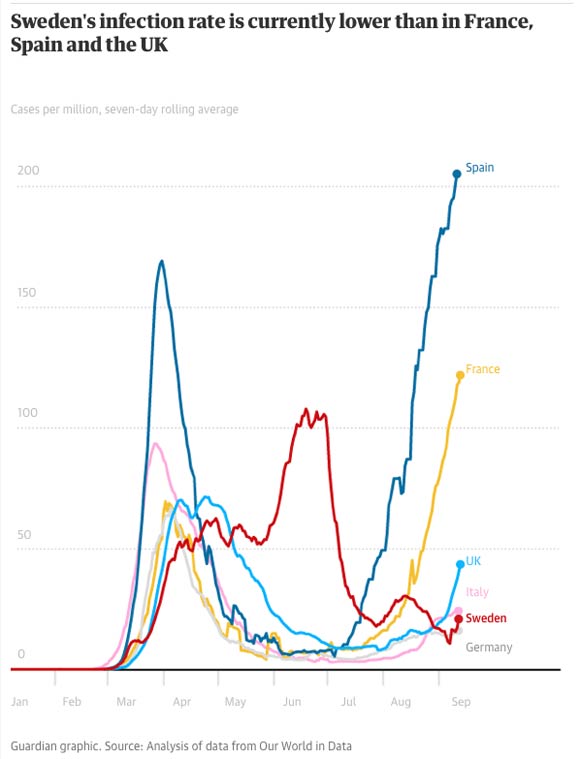
Meanwhile, in Sweden, infection rates have reached an all-time low. As reported by The Guardian, September 16, 2020:7
"According to the European Centre for Disease Prevention and Control (ECDC), the Scandinavian country's14-day cumulative total8 of new caseswas 22.2 per 100,000 inhabitants on Tuesday, against 279 in Spain, 158.5 in France, 118 in the Czech Republic, 77 in Belgium and 59 in the UK, all of which imposed lockdowns this spring.
Twenty-two of the 31 European countries surveyed by the ECDC had higher infection rates. New cases, now reported in Sweden only from Tuesday to Friday, are running atroughly the rate seen in late-March, while data from the national health agency showed only 1.2% of its 120,000 tests last week came back positive …
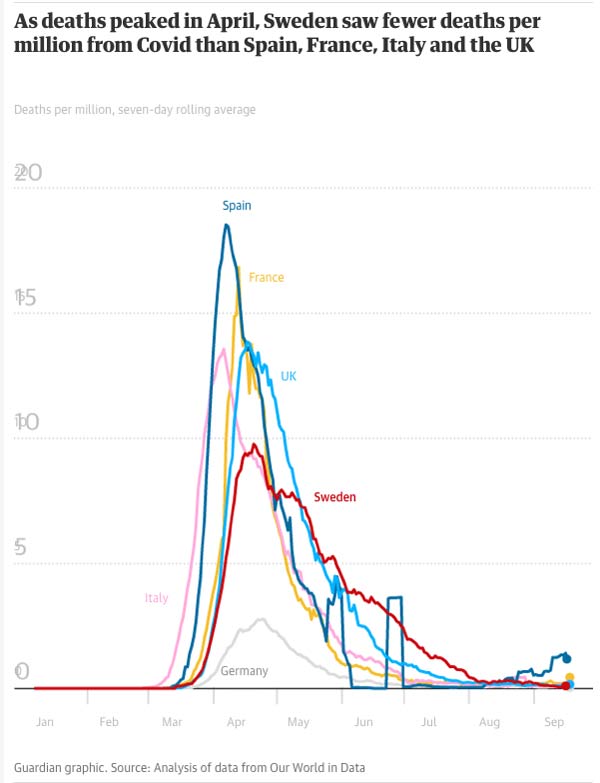
Thirteen Covid-19 patients are in intensive care in Swedish hospitals, and its seven-day average of coronavirus-related deaths is zero."
The two graphs from The Guardian, below, show Sweden's infection rate and deaths per million, compared to other countries that enforced stricter lockdown rules.
High Mortality Was Due to Nursing Home Failures
Initially, Tegnell's approach came under fire as Sweden's death toll soared five to 10 times higher than its neighboring countries, Denmark, Norway and Finland. However, Tegnell insists this early spike in deaths was not due to a lack of lockdowns or social distancing in general, but rather due to a failure to prevent infection in nursing homes, where a majority of the deaths actually occurred.
"Of course something went wrong there," Tegnell told The Guardian.9 Other than that, Swedish authorities insist the strategy to encourage and trust citizens to take personal responsibility for their health and well-being has been the correct one.
Contrary to other nations, Sweden's decision has also resulted in consistent public messaging about disease prevention, thereby avoiding the confusion, frustration and distrust that comes from getting mixed messages.
In April 2020, Emma Frans, science communicator and a postdoctoral researcher in medical epidemiology at the Karolinska Institutet in Stockholm, told the National Review:10
"The strategy in Sweden is to focus on social distancing among the known risk groups, like the elderly. We try to use evidence-based [measures]. We try to adjust everyday life. The Swedish plan is to implement [measures] that you can practice for a long time."
The Vanishing Middle-Class
As a result of their sensible approach to the pandemic, Sweden has also largely escaped the financial ruin experienced in other areas, including the U.S. This also means they've minimized the impact of the pandemic on mental health. As Tegnell told11 The Daily Mail, April 4, 2020, "We can't kill all our services. And unemployed people are a great threat to public health. It's a factor you need to think about."
Indeed, preventing healthy people from working is upending the middle-class in the U.S. and elsewhere, and has (as expected) resulted in a massive rise in suicide and other tragedies. As noted by Robert F. Kennedy Jr. in "How the Government Uses Fear to Control," research from the 1980s found that for every 1-point rise in unemployment there were 37,000 excess deaths, 4,000 excess imprisonments and 3,300 excess admissions into mental institutions.
Kennedy also cites recent data from a hospital in San Francisco that stated they saw one year's-worth of suicides in a single month, a 1,200% increase, and British research showing that while there were 30,000 excess deaths in nursing homes during a five-week period during the lockdown, only one-third of them were due to COVID-19.
In other words, the death rate from isolation was double that of the virus itself. People didn't get the proper medical care for chronic conditions and so on. Kennedy also rightly points out that what we will see — and are already seeing — is the obliteration of the middle-class and the shift of wealth from the poor to the already ultra-rich.
A September 20, 2020, article12 in The Wall Street Journal highlights the financial devastation experienced by the American "loan-laden white-collar" middle-class. Journalist AnnaMaria Andriotis tells the story of Alysse Hopkins, a Rockland County, New York foreclosure and personal-injury lawyer:
"In a good year, the 43-year-old lawyer and her husband, Ian Boschen, 41, together brought in about $175,000, the couple said — enough to cover the mortgage, two car leases, student loans, credit cards and assorted costs of raising two daughters in the New York City suburbs.
After the coronavirus halted many foreclosures and closed courts, her work dried up. Unemployment benefits have helped, Ms. Hopkins said, but the family is running low on savings and can't keep up with $9,000 in monthly debt payments including mortgage installments. 'It frustrates me to not be able to earn a living,' she said. 'I have a law degree, almost 20 years of practice' …
While lower-wage workers have borne much of the brunt, the crisis is wreaking a particular kind of havoc on the debt-laden middle class … The coronavirus has spared few industries and expanded unemployment benefits designed to replace the average American income didn't cover all the lost pay of higher-earning workers, especially in or near expensive cities.
The extra $600 weekly payments expired in July, putting them even further behind. 'What I see happening here is a core assault on successful college-educated families, which are the new breed of middle-class American families,' said Anthony Carnevale, director of the Georgetown University Center on Education and the Workforce. 'There's a professional workforce that's getting slammed.'"
Lockdowns Have Likely Done More Harm Than Good
So far, most efforts to curb COVID-19 infection have proven to be ill advised. Evidence shows the illness spreads mostly indoors,13,14,15 for example, casting doubt on the sanity of closing parks and beaches, especially during the summer.
Importantly, the total all-cause mortality is not significantly different than in previous years, as discussed by my interview with Denis Rancourt. Many other deaths have been shifted to COVID-19, bringing a high spike in deaths, but when you look at the area under the curve for total deaths, it really doesn't differ from previous years.
This statistic has also been highlighted by the American Institute for Economic Research.16 As early as April 2020, they referred to the COVID-19 pandemic as "An egregious statistical horror story" that resulted in "a vandalistic lockdown on the economy," which:
" … would have been an outrage even if the assumptions were not wildly astronomically wrong. Flattening the curve was always a fool's errand that widened the damage …
The latest figures on overall death rates from all causes show no increase at all. Deaths are lower than in 2019, 2018, 2017 and 2015, slightly higher than in 2016. Any upward bias is imparted by population growth.
Now writing a book on the crisis with bestselling author Jay Richards, [statistician William] Briggs concludes: 'Since pneumonia deaths are up, yet all deaths are down, it must mean people are being recorded as dying from other things at smaller rates than usual.' Deaths from other causes are simply being ascribed to the coronavirus.
As usual every year, deaths began trending downward in January. It's an annual pattern. Look it up. Since the lockdown began in mid-March, the politicians cannot claim that their policies had anything to do with the declining death rate.
A global study17 published in Israel by Professor Isaac Ben-Israel, chairman of the Israeli Space Agency and Council on Research and Development, shows that 'the spread of the coronavirus declines to almost zero after 70 days — no matter where it strikes, and no matter what measures governments impose to try to thwart it.'
In fact, by impeding herd immunity, particularly among students and other non-susceptible young people, the lockdown in the U.S. has prolonged and exacerbated the medical problem."